A great pleasure in life is doing what others say you can't!
Restoring Cursive Handwriting Instruction

A Policy Recommendation for Strengthening Literacy and Academic Foundation
Prepared for: Lynden School District Board of Directors
Prepared by: School Board Director Nicholas E. Sawka
Date: 28MAY26
Executive Summary
Recent literacy assessments show continued challenges in student reading proficiency nationwide. Results from the National Assessment of Educational Progress (NAEP) indicate stagnation and, in some grade levels, decline in reading performance over the past decade.
At the same time, instruction in cursive handwriting has been eliminated in many districts throughout the state as curriculum has shifted over the past 16 years. Emerging research suggests that cursive handwriting along with printing supports reading fluency, spelling retention, fine motor development, and long-term memory formation.
This paper recommends that Lynden School District restore structured cursive instruction in 3rd grade as a cost-effective strategy to reinforce foundational literacy skills.
1. Introduction
Literacy is at the foundation of academic success. Reading proficiency by third grade strongly predicts future academic achievement, graduation rates, and workforce readiness. While technology has reshaped education, foundational skills remain essential. The removal of mandated cursive instruction from many curricula has raised concerns among teachers, parents, and literacy specialists about unintended consequences.
2. Cursive Handwriting Instruction Reduction
2.1 Literacy Challenges
Lynden School District reports above average proficiency in reading when compared to the rest of Whatcom County. According to the Office of Superintendent of Public Instruction (OSPI) a good number of students are still not meeting grade-level standards when it comes to English Language Arts.
The good news is that by middle school, reading outcomes in Lynden mirror state averages, with almost half of students meeting or exceeding proficiency benchmarks. Reading proficiency improves by high school as well. But there is still more work to be done in this area. Many students still fall short of proficiency, indicating that earlier gaps in literacy may carry into later grades.
2.2 Reduction in Handwriting Instruction
With policies like the No Child Left Behind Act, the focus was shifted more towards subjects that could be tested, and provide data points like reading and math. Because handwriting and cursive was not widely tested many districts had to reduce the amount of classroom time spent on curriculum that affected accountability scores. As a result, cursive became optional and started to fade away from the learning environment.
When national academic standards changed and we shifted to Common Core Standards back in 2010, cursive handwriting was not included as a required skill.
This is where cursive really started its downhill slide nationally. Even though it's not a requirement, 25 states have signed legislation to require some form of cursive handwriting instruction to students between the grades 3-5. Currently, Washington State is not one of them. Most recently House Bill 2262 was introduced which would have made cursive signature development a part of civics education curriculum but sadly the bill didn’t pass.
3. Research and Background
3.1 Cognitive Development
Cursive handwriting supports the development of fine motor skills; it requires coordinated finger, hand, and wrist movement to create a continuous motion. Cursive handwriting encourages deliberate processing and sustained attention.
Cursive handwriting provides a mechanical advantage to the writer. A simple 300-word essay can require thousands more pen strokes when printing due to repeated lifting and the starting of letters. This can and will also lead to greater writing fatigue for the writer.
Cursive on the other hand can increase writing speeds and endurance for extended writing tasks while prompting sequencing and word formation. We should want our children to become the most efficient learners possible.
Research in cognitive skills and education demonstrates that handwriting, particularly cursive, plays an important role in development. Cursive handwriting integrates fine motor skills, visual processing, and memory, resulting in deeper cognitive engagement (Mueller & Oppenheimer, 2014; Van der Meer & Van der Weel, 2020).
3.2 Literacy Reinforcement
Cursive writing can improve letter recognition because the letters are connected and written in consistent stroke patterns; students are more likely to internalize the structure of words, reinforcing it to memory. Neuroscience studies show that handwriting of any kind activates complex neural networks related to memory formation. Brain imaging research shows greater connectivity between regions associated with learning and memory.
While there is limited research directly comparing cursive and print handwriting, there is evidence that cursive writing can preferentially increase the speed and fluency of writing and reading for some students, especially those with handwriting difficulties like dyslexia.
Compared to typing, cursive writing has been associated with specific patterns of electrical activity in the brain which have been associated with learning and reading in children and adults. Eliminating cursive may inadvertently weaken reinforcement of these foundational skills. Cursive handwriting supports literacy development by strengthening fine motor coordination, reinforcing letter recognition, and activating/strengthening neurological pathways associated with reading and language processing.
3.3 Effect Size Impact and Measurable Literacy Improvement
One of the most comprehensive analyses on this topic was conducted by Santangelo and Graham (2016), which examined the effects of handwriting instruction across multiple grade levels and educational settings.
Interpreting Effect Size
- 0.20 = Small effect
- 0.50 = Medium effect
- 0.80+ = Large effect
Handwriting fluency showed a moderate-to-strong effect (ES ≈ 0.63), indicating that students who receive instruction can write more quickly and efficiently. This increased fluency allows students to keep pace with their thoughts during writing tasks, reducing cognitive overload, and improving overall composition.
In addition to fluency, handwriting instruction significantly improves legibility (ES ≈ 0.59). This ensures that student writing is clear and readable, allowing teachers to accurately assess knowledge and reduce misunderstandings caused by poor handwriting.
Importantly, the benefits of handwriting instruction extend beyond mechanics. Santangelo and Graham (2016) found a strong effect on overall writing quality (ES ≈ 0.84), demonstrating that students produce more organized, coherent, and developed written work when they are not hindered by the physical act of writing.
These findings emphasize the importance of transcription skills, including handwriting, as a foundational component of writing development. When handwriting becomes automatic, students are better able to focus on critical literacy skills such as vocabulary usage, grammar, and comprehension. Schools that prioritize handwriting are not reverting to outdated practices; rather, they are implementing an evidence-based approach that supports both foundational skills and higher-order academic achievement.


3.4 National Literacy and the State of Washington
When comparing the state of Washington to national averages, we perform slightly above or near the national average in reading. This mirrors the same stagnation and post pandemic declines seen across the country. We consistently ranked between 15-20 when it comes to national rankings. While we are not underperforming relative to peers, it is also not demonstrating meaningful literacy gains. Please reference the list at the end of this document to see what we stand on the national list.
3.5 California Assembly Bill 446
In 2023, the state of California passed Assembly Bill 446 (AB 446), which required cursive instruction between grades 1-6, teaching students to both read and write in cursive and for this to be implemented beginning in the 2024-25 school year.
In practice, this will work by having the students learn cursive strokes through grades 1-3 and to build toward fluency between grades 4-6. Lawmakers cited concerns about fine motor skill development, losing the ability to read cursive text, and other research linked to letter recognition and reading development. California lawmakers believe that this bill could help the state climb the national ladder when it comes to literacy.
3.6 Historical and Civic Literacy
From founding documents to letters from our grandparents, cursive handwriting is all around us. Thomas Jefferson, using cursive handwriting wrote the Constitution and Declaration of Independence, with help from others like Benjamin Franklin and John Adam who provided their feedback in cursive handwriting. Teaching cursive helps the student to access and interpret historical documents directly. Without cursive literacy, students will be dependent on transcripts rather than original sources. Oftentimes items get lost in translation, having the original copy helps to maintain the integrity of the source material. This gives tremendous value to learning how to read and write the cursive alphabet.

4. Proposed Policy Recommendation
4.1 Policy Statement
Before the district should even consider implementing any sort of policy, we should first see if this is a priority for both staff and families. We shall conduct a district wide parent and elementary staff survey. This will give us the opportunity to come up with the best roadmap if one is needed. Other private schools within the City of Lynden (Christian Cornerstone, Ebenezer Christian, and Lynden Christian) see the value of teaching cursive handwriting to their students.
Currently the Lynden School District values but does not mandate cursive instruction. Our current curriculum K/5 ELA includes cursive instruction at grades 3 and 4, but again this is not mandated which leads to some kids getting the skills to write in cursive and others not depending on the student’s teacher and or school. There is also an additional supplement material in the form of a cursive writing workbook. We need to make sure that students, no matter what teachers they have, receive the same standard level of instruction.
We need to look at all of our 3rd and 4th grade teachers to see the amount of time each is spending on cursive instruction and to come up with strategies that can help us build a policy that will work for the teachers and the students if the parents see this as a priority.
4.2 Other Schools Instructional Framework
Christian Cornerstone uses the traditional Zaner-Bloser method. Cursive handwriting is formally taught in 3rd grade. It is reviewed with focus in 4th, and encouraged in the grades that follow. This means that students may not be required to do everything in cursive but sometimes a teacher will ask for a particular assignment to be done in that style.
Ebenezer Christian School starts with the Learning Without Tears cursive handwriting book in late second grade. In third grade, students move to the Zaner-Bloser method to learn all the letters. In fourth grade students continue to refine cursive skills with their written work.
Lynden Christian introduces the letters in 3rd grade with the goal of writing mostly in cursive by the end of the year. The requirement is to have all of their 4th grade students writing in cursive, and the requirement continues for 5th and 6th grade. Lynden Christian also uses the Zaner-Bloser method along with A Reason for Handwriting series which is a Christian focused curriculum.
4.3 Cost Considerations
Implementation costs are minimal and will include Instructional material that the district currently has on hand. Printing of practice materials should be the only cost that the district incurs. No major infrastructure investment is required.
4.4 Lynden Schools Cursive Policy Recommendation
- 20 minutes per day twice a week
- During the entirety of 3rd grade school year
- Use the CKLA supplemental cursive workbook
- Focus on letter formation, word fluency, and sentence writing
- Professional development workshop for teachers (1 half-day session)
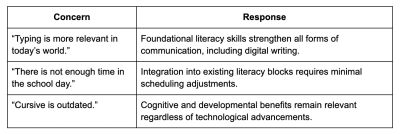
5. Counterarguments and Responses
The need for cursive handwriting instruction is something that faculty members and families generally support. It’s up to us and the community to make it a priority. We can’t wait for lawmakers to create a law; it’s up to us as a community to say that it’s worthy of classroom instructional time. Below are some concerns that I found online along with responses.
6. Data Gathering Timeline
First, we must see if this is a priority for the parents that the district serves. During our annual survey we should add a question(s) seeking input on bringing mandated cursive handwriting instruction back to our curriculum. We need to see if there is a need for this and how high on the priority list parents value it.
Next, we need to gather data on the length of time spent each week on Cursive Instruction and the percentage of teachers that are making it a priority in the classroom. Collecting feedback from the facility will be a key component to making sure that we set the appropriate expectations for instruction. For example, as a district we might just want to set an expectation that every student knows how to sign their name in cursive prior to entering the 6th grade.
Lastly, based on all the data gathered, we should reflect on what we are doing as a district to determine if we are spending the appropriate amount of time on Cursive Handwriting.
7. Evaluation Metrics
To assess the effectiveness of Cursive Handwriting we might want to compare literacy scores before and after implementation. This wouldn’t be a one for one comparison but it should help us see if the more focus on handwriting is helping to improve our scores. We should be able to use our local assessments from our elementary schools and state assessments to obtain the data that we need for comparison. Some areas for us to compare would be reading fluency scores, writing fluency benchmarks, and teacher feedback surveys.
8. Conclusion
Restoring cursive instruction represents a low cost, evidence-informed strategy to strengthen foundational literacy skills. This will provide cognitive and academic benefits that support student success in the long term.
While some teachers in the district at the elementary level may be introducing students to cursive handwriting as part of additional instruction, this creates an uneven education standard within our district. Every student should have the opportunity to learn how to write in cursive and at a minimum we should require students to learn how to sign their name in cursive. An individual’s signature is very unique to their person. As signatures go, we came from an X, to an actual signature then back to a digital X.
If our state leaders passed a law, we would be forced to implement it. If our governor signs an executive order, we have to implement it. If the School board drafted a resolution and it passed, the district would have to implement it. Why wait for external mandates when districts have the ability to implement effective, research-based practices locally?
25 States nationwide have reinstated cursive handwriting in their curriculum. Based on these findings, it’s my opinion that we should not wait for the State of Washington, but to lead from the front. This will allow us to build trust locally while providing our students a competitive edge over districts that don’t offer cursive handwriting skills. I believe this is an example of how we can use local control to benefit our kids academically.
In conclusion, as I was preparing this research it became more evident to me that it’s not so much about learning cursive but answering the question of what it does for the young human brain and how we can foster student growth. The Lynden School District Board of Directors is strongly encouraged to mandate a uniform approach to cursive handwriting instruction in the upcoming academic years.
Appendix
References And Research Charts
- Askvik, E. O., van der Weel, F. R. R., & van der Meer, A. L. H. (2020). The importance of cursive handwriting over typewriting for learning in the classroom: A high-density EEG study of 12-year-old children and young adults. Frontiers in Psychology, 11, 1810. https://doi.org/10.3389/fpsyg.2020.01810
- James, K. H. (2017). The importance of handwriting experience on the development of the literate brain. Current Directions in Psychological Science, 26(6), 502–508. https://doi.org/10.1177/0963721417709821
- James, K. H., & Engelhardt, L. (2012). The effects of handwriting experience on functional brain development in pre-literate children. Trends in Neuroscience and Education, 1(1), 32–42. https://doi.org/10.1016/j.tine.2012.08.001
- Mangen, A., & Balsvik, L. (2016). Pen or keyboard in beginning writing instruction? Some perspectives from embodied cognition. Trends in Neuroscience and Education, 5(3), 99–106. https://doi.org/10.1016/j.tine.2016.06.003
- Mueller, P. A., & Oppenheimer, D. M. (2014). The pen is mightier than the keyboard: Advantages of longhand over laptop note taking. Psychological Science, 25(6), 1159–1168. https://doi.org/10.1177/0956797614524581
- MyCursive. (n.d.). States that require cursive writing. https://mycursive.com/states-that-require-cursive-writing/
- Santangelo, T., & Graham, S. (2016). A comprehensive meta-analysis of handwriting instruction. Educational Psychology Review, 28(2), 225–265. https://doi.org/10.1007/s10648-015-9335-1
- van der Meer, A. L. H., & van der Weel, F. R. (2020). Neural mechanisms underlying handwriting and drawing: A review of functional MRI studies. Frontiers in Psychology, 11, 1810. https://doi.org/10.3389/fpsyg.2020.01810
- Washington Office of Superintendent of Public Instruction. (2024). Washington State report card: District assessment results (ELA). Olympia, WA.
- Whitley, B. (2021, March 8). Cursive writing. MOST Policy Initiative. https://mostpolicyinitiative.org/science-note/cursive-writing/
Cursive Instruction vs. Common Core (All 50 States)
States with strict Common Core alignment and no cursive requirement are more frequently found in the middle and lower performance tiers. Washington State falls into this category, indicating an opportunity to strengthen foundational literacy practices through more consistent handwriting instruction.
CURSIVE INSTRUCTION VS. COMMON CORE (ALL 50 STATES)


State Performance Compared to the Nation: Data Table


